


Nationwide, there are nearly 40,000 homeless U.S. veterans. NeighborWorks network organizations are working to reduce that number. One of those organizations is Southwest Solutions.
Situated in Detroit, Michigan, the organization runs Piquette Square, which has 150 apartment homes for veterans coming out of homelessness. Michael Sanders has lived there for the past four years. "I served in the Navy, doing construction," shares Sanders. "My father was a police officer at the time. And the military seemed like the right choice for me."
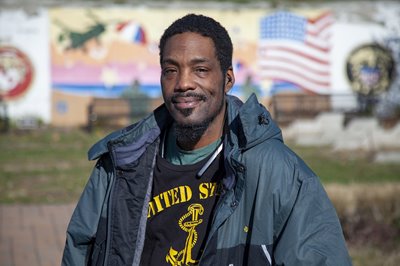 After serving for three years, during which he supported construction and rebuilding efforts in places like Cuba and Puerto Rico, Sanders became an inspector for the city of Detroit. That lasted 10 years, he says. He married and had children, but eventually divorced. "My life started spiraling down after a while," he says. "Between drinking and mental issues not being treated, I ended up losing everything." That included his home.
According to the Department of Housing and Urban Development's 2020 Annual Homeless Assessment Report, on a single night in January 2020, there were more than 37,000 homeless veterans in the U.S., a slight increase over 2019. But by then, Sanders wasn't one of them.
He received treatment for depression and PTSD at a Detroit center for veterans. Staff from Southwest Solutions helped him find a job and file for social security. "Then I moved to Piquette Square," he says.
Being around other vets has been a huge plus for Sanders. "They understand me more so than the general public," he says. Southwest Solutions also offered support services. "They keep in touch with me," Sanders says. "I can call them and discuss business and personal things."
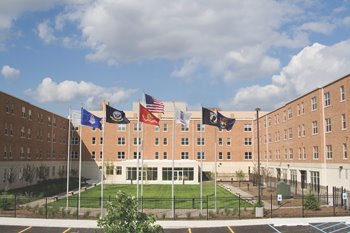 That includes working on his credit score, his job search (Sanders lost his job when the pandemic began), and groceries. There are social aspects, too, like barbecues and symphonies. Sanders says Piquette Square has been a good fit for him and for one of his sons, who needs full-time care and lives with him. As he navigates COVID, Sanders says he's deciding on his next career. He hopes to someday start a business, now that he feels secure and has a home.
Southwest Solutions launched Piquette Square 11 years ago, says Jamie Ebaugh, executive director of the NeighborWorks nonprofit. "We were housing a lot of veterans in our permanent supported housing programs, and we were aware that the needs of veterans were a little different from the average homeless person," he says.
The apartment complex, which is nearly always at capacity, is situated a mile from the Veterans Administration in Detroit. "We didn't want to become a treatment center or duplicate services," Ebaugh says. "We did want to provide support services that focused on housing stability." That means helping residents apply for food stamps and connect to other basic needs. Staff members work with veterans from the moment they arrive to fill out paperwork and register for services.
Deciding which services to provide onsite was a bit of trial and error, Ebaugh says. Hosting meetings for those in therapy or recovery from substance abuse at Piquette Square met with resistance from residents who wanted to maintain more anonymity. So those activities moved off-site. The Gleaners Mobile Grocery, which serves individuals paying in cash or food stamps, became popular, so that remains a weekly food source, providing food at a third the cost of a traditional grocery store. And each year, tax preparers come to aid veterans during tax time.
"We know that providing supportive services and resident services really helps individuals as they work toward their own, personal goals," says Clare Rosenberger, NeighborWorks director of real estate programs. "Once we get stable housing in place – which our network organizations are so good at doing – we can connect individuals with services that help with a lot of the inherent challenges that homelessness can exacerbate or make more difficult." That includes connecting individuals to financial coaching, job training and healthcare.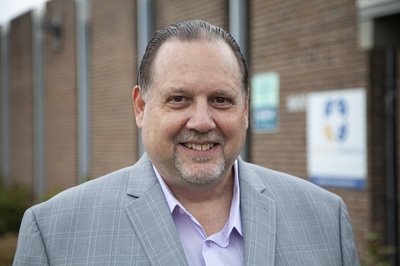
Another thing NeighborWorks network organizations do well? "Community building and resident engagement," Rosenberger says. "That's especially helpful as individuals transition out of homelessness."
To apply to become a Piquette Square resident, "there are only two requirements: That you're homeless and that you're a veteran," says Ebaugh. Residents, who range in age from their 20s to their 80s, can stay as long as they'd like. Some use the complex as a stepping stone to other housing. Others make it their permanent home. Each floor has a tenant captain who checks in regularly with residents.
"Our goal is to keep people stably housed for as long as choose to be here, and to connect them to the community. You have to feel like you're a viable member of the community you're involved in." That may mean connecting residents with volunteer work – at churches or with a local reading program, for example. It may mean connecting them with Southwest Economics, a sister program that provides job training.
Because of Southwest Solutions' involvement with Piquette Square, the nonprofit received a grant through the VA that helps them assist veterans at risk of homelessness with rent and other programs. Through that grant, the Detroit nonprofit assists over 400 vets a year.
"Piquette Square was our first 'jumping in,'" Ebaugh says. "But we've grown into a wide range of supporting and serving our veterans."
11/11/2021