


For many organizations across the NeighborWorks® network, housing conversations center around affordability, supply and rising costs. In Alaska, those conversations also include isolation, shrinking population, disappearing industries, extreme weather conditions and the reality that even keeping existing affordable housing ready residents can feel fragile.
During a recent visit to Anchorage to attend the Housing Our Relatives Summit, hosted by NeighborWorks America, the National American Indian Housing Council and Oweesta Corporation, leaders from NeighborWorks met with the team at NeighborWorks Alaska to better understand the challenges shaping housing and community development across the state and the innovative ways local leaders are responding.
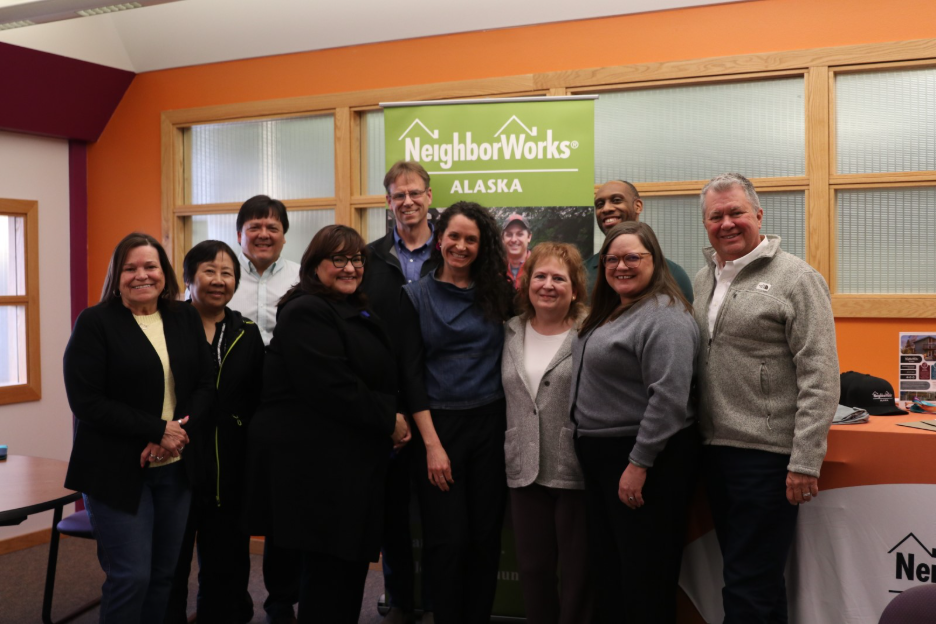
The visit brought together NeighborWorks America President & CEO Marietta Rodriguez, Senior Vice President of Field Operations Katie Watts, Senior Vice President of National Initiatives Bryan Brown, Director of Communications Arian Tyler and Relationship Manager Shu Chen with NeighborWorks Alaska leadership, staff and board members.
From the opening conversation, one message was clear: Alaska’s housing realities require a different lens.
“We’re really excited to be in the great state of Alaska,” Rodriguez told staff during the visit. “We don’t get to come here as often as we’d like. But we see you, we value you and we know the difficult conditions economically that you’re dealing with.”
Throughout the discussions, NeighborWorks Alaska leaders described the pressures reshaping Anchorage and communities across the state. The decline of the oil and timber industries, shifts in seafood processing and broader economic uncertainty have created ripple effects throughout local neighborhoods and housing markets. Meanwhile, housing costs continue climbing even as population growth slows.
“The average price of a home is over $500,000 here,” said Jim Mackenzie during the conversation. “Our kids are not staying.”
NeighborWorks Alaska leaders also spoke candidly about the balancing act required to preserve affordability while protecting long-term organizational sustainability.
“There’s tons of efforts happening,” Mackenzie said. “But there’s just not enough money.”
The conversations highlighted another challenge unique to Alaska: vulnerability.
When national retailers leave the market, communities can lose critical services. When affordable housing inventory disappears, replacement options are limited. When construction costs rise, development becomes harder to justify financially.
That reality has pushed NeighborWorks Alaska toward a deliberate and highly strategic approach to housing preservation and acquisition.
“If we’re going to grow, acquisition is really where we have to look,” Mackenzie said. “But we have to make intentional, transparent decisions.”
The visit also showcased the strength of the NeighborWorks network model and the importance of technical assistance, peer learning and long-term partnership.
Mackenzie credited NeighborWorks America and network relationships for helping the organization navigate portfolio preservation, organizational transitions and strategic planning efforts over the years.
“The wealth of information and knowing we can reach out and get an immediate answer, it truly is amazing,” Mackenzie said.
Beyond the meetings, the tour included visits to housing properties and neighborhoods across Anchorage, where leaders discussed supportive housing models, neighborhood revitalization efforts and long-term preservation strategies.
At multiple stops, the conversations returned to a broader theme: housing stability affects everything. Economic mobility. Workforce retention. Public health. Community connection.
And in Alaska, where environmental conditions, construction costs and geographic isolation amplify nearly every challenge, the margin for error is often small.
“There’s no one-size-fits-all approach to housing,” Rodriguez said during the visit. “Communities closest to the challenges are often closest to the solutions.”
For NeighborWorks America, the Alaska visit reinforced the importance of listening directly to network organizations and understanding the realities shaping communities on the ground.
Because while the challenges may look different in Alaska, the mission remains the same: creating opportunities for people to live in affordable homes, improve their lives and strengthen their communities.