


Nearly half of U.S. adults are interested in buying a home, according to a recent national survey from NeighborWorks® America. But 38% of Gen Zers and 32% of Millennials fear they’ll never actually own one. Still, there are people out there showing that it can be done.
Shannon Ogden, a new homeowner who identifies as Gen Z, always thought she’d own a home someday. But the mental health therapist feared it might be years before she did.
That changed when the Gen Zer moved into a home of her own this May. She’s not the only one of her friends set to own a home, she says, but she finds that those she knows who do own homes often had family help.
According to the NeighborWorks survey, 20% of adults received help from family when saving for the down payment and 25% of the 18-34 age group received help from family.
In her own situation, Ogden’s parents bought the home first – a cash purchase from the public administrator’s office for a two-story Colonial home in Rochester, New York. They sold the house back to her at just below the assessed value, which made it possible for her to afford her own mortgage.
Ogden said she’d wanted to buy a home because she wanted to build equity and because she hoped to find a mortgage payment that was lower than her rising rent. One obstacle she’d been unaware of: How her college loans would impact her debt-to-income ratio. Still, she was able to make it all work.
Ogden worked with a housing counselor at Pathstone and received a first-time homebuyer grant through her mortgage lender. What would she tell other people her age – or any age – who were looking for a home? “I think a lot of people don't realize how little you actually need to put down,” she says. She’s right. According to the NeighborWorks survey, nearly 60% of U.S. adults overestimate how much money is needed for a down payment.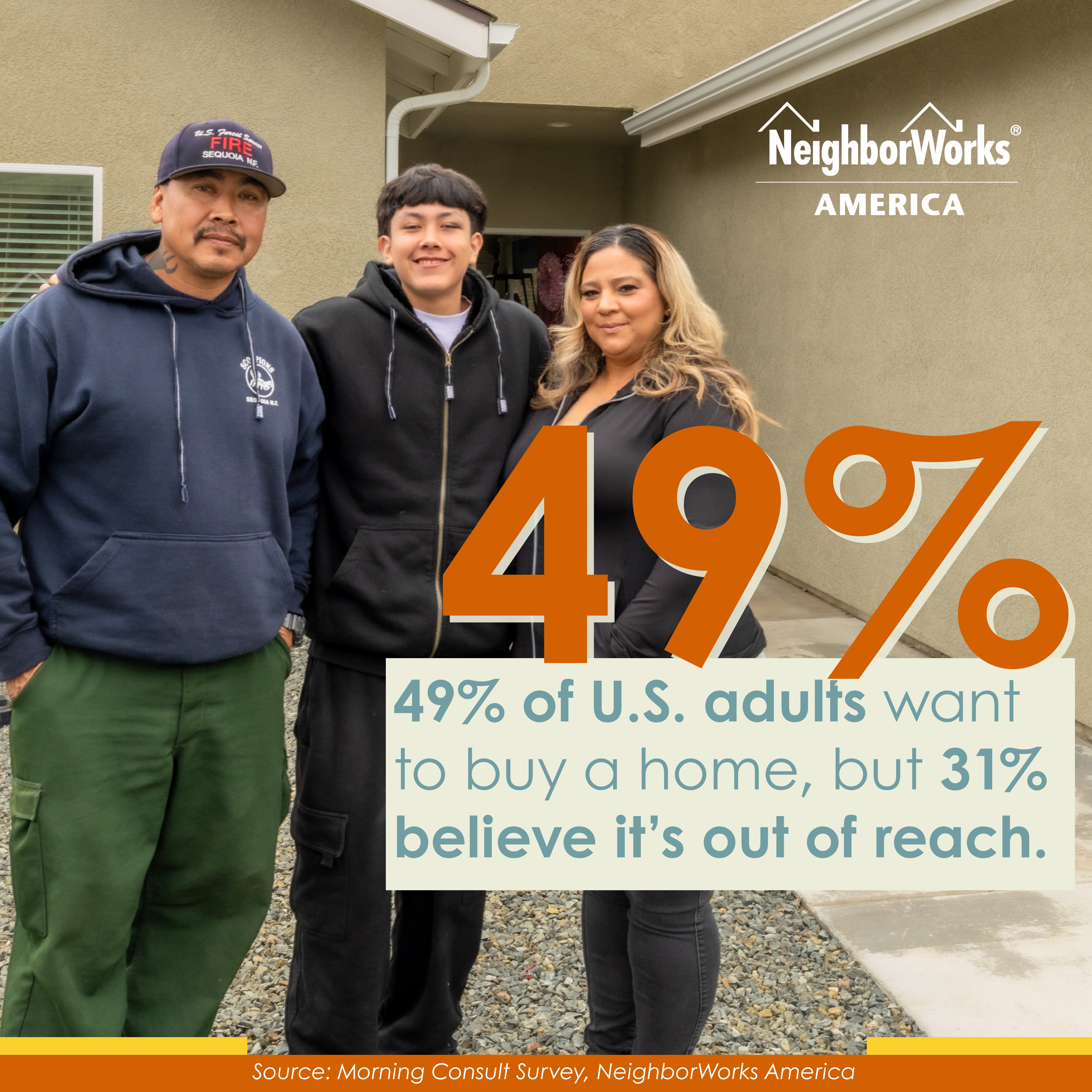
Also, Ogden says, it’s important to be flexible. “If owning a home is really important to you, you may need to be flexible about where it’s located.” The same is true for the home’s size or condition. Her own house still needs some renovating, she says. But already, it feels like home.
Veronica Tobin of NHS of Baltimore says that she sees customers of all ages. “But when it comes to younger people – people under 40 – the fear a lot of them have is that they’re afraid of that mortgage commitment. They’re afraid of being responsible for all of it.”
Others she speaks with are dealing with credit issues, and that’s regardless of age. “It doesn’t even matter what their income is,” she says. Whether they’re earning $60,000 a year or $100,000 a year, “credit is the No. 1 issue that prevents people from moving to the next step.”
Housing counselors serve as advisers. As a third party who can advise without financial gain, clients come to see them as trusted, once the clients learn more about what they do. “They get the feeling we’re looking out for them,” she says.
Meredith McCallister is in her early 50s. A housing counselor herself at Go Northwest, she recently bought a town home with help from NHS of Baltimore and felt that trusted relationship on a different level. “I’m an empty nester now and I decided I wanted to buy a home instead of continuing to rent,” she says. “In Baltimore, the rent just kept going up and up.”
One weekend, she was sitting at a table next to a loan officer from NHS of Baltimore at a housing event when she heard about their mortgage product. “I was like ‘oh!’” She followed up immediately.
The process went smoothly, she says, but as much as she knew about buying a home – last year she counseled 220 families – it was still stressful. She’d owned a home with her husband when she was married, she says. “But doing it on my own I was a bit more anxious. I have a whole other level of empathy for my clients now, truthfully.”
To buy her home and prepare for her mortgage, she used some of her savings to pay down credit card debt to boost her credit score and to get a better loan deal. Meanwhile, NHS of Baltimore was able to find some incentives to help offset the down payment and closing costs her savings might have covered. Her payments are lower than her rent had been, she says, which allows her to put more money into retirement savings.
For those who are looking to buy a home, there are still pathways to find them. NeighborWorks is calling attention to three programs – down payment assistance, credit strengthening and more education and understanding of the process – to help show people a clearer path to affordable homeownership.
“Homeownership may not be the best choice for everyone at every point in their life, but for so many people to believe that owning a part of the American Dream is unattainable is sobering,” said NeighborWorks America President & CEO Marietta Rodriguez. “These results should energize everyone across the homeownership sector to see where they can make changes to give millions of people more hope.”